Help and Support

How to use the mail merge to create mailing labels in Word

Article ID:294684
Last Review:January 31, 2007
Revision:4.1
This article was previously published under Q294684
For a Microsoft Word 2000 version of this article, see 212034 (http://support.microsoft.com/kb/212034/).
For a Microsoft Word 97 version of this article, see 195609 (http://support.microsoft.com/kb/195609/).
For a Microsoft Word 7.0 version of this article, see 141992 (http://support.microsoft.com/kb/141992/).
On This Page

SUMMARY

This article describes how to use the Mail Merge feature in Microsoft Word to create labels. A mail merge involves merging a main document with a data source.

A main document contains the text and other items that remain the same in each label. A data source contains the information that changes in each label, such as the name and address of each recipient.

Merge fields that you insert into the main document instruct Word where to print information from the data source. When you perform the mail merge, Word replaces merge fields in the main document with information from the data source. Each row (or record) in the data source produces an individual label.

The following procedure demonstrates how to perform a mail merge to create labels.

Back to the top

Step 1: Create the main document

Start a new document to create a new label, or open an existing document that you used previously to merge labels.
1.Open the document in Word, and then start the mail merge. To start a mail merge, follow these steps, as appropriate for the version of Word that you are running:
Microsoft Word 2002

On the Tools menu, click Letters and Mailings, and then click Mail Merge Wizard.
Microsoft Office Word 2003

On the Tools menu, click Letters and Mailings, and then click Mail Merge.
Microsoft Office Word 2007

On the Mailings tab, click Start Mail Merge, and then click Step by Step Mail Merge Wizard.
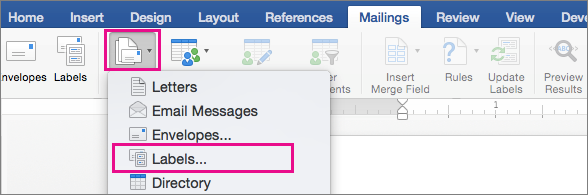
2.Under Select document type, click Labels, and then click Next: Starting Document.

Step 2 of the Mail Merge appears.
3.Under Select starting document, click Change document layout or Start from existing document.

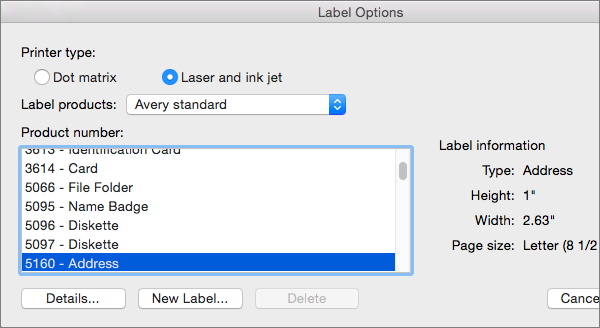
With the Change document layout option, you can use one of the mail-merge templates to set your label options. When you click Label options, the Label Options dialog box appears. Select the type of printer (dot matrix or laser), the type of label product (such as Avery), and the product number. If you are using a custom label, click Details, and then type the size of the label. Click OK.

With the Start from existing document option, you can open an existing mail-merge document and use that as your main document.
4.Click Next: Select Recipients.

Back to the top

Step 2: Select the data source

The data source contains the information that can vary in each label. You can open an existing data source created in Word, or you can create a new data source and fill in the addressee information.

Note Additionally, you can use a data source that was created in another program, such as Microsoft Excel or Microsoft Access, or you can use a personal address book created in Microsoft Exchange Server or Microsoft Schedule+, or you can use an ASCII text file or another delimited file.
1.Under the Select Recipients heading in the Mail Merge task pane, select the appropriate data source option.

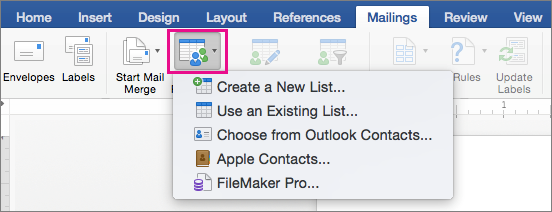
The options are to use an existing list, select from Outlook contacts, or type a new list.
2.Use the appropriate method for the type of data source that you want to use.
Method 1: Open an existing data source

To open an existing data source, follow these steps:
a. In the Mail Merge task pane, click Use an existing list, and then click Browse under the Use an existing list heading.

The Select Data Source dialog box appears.
b. In the list of files in the Select Data Source dialog box, select the data source that you want to use, and then click Open.

If the data source that you want is not in the list of files, click the appropriate drive and folder, and then select the appropriate option in the List files of type box.

Word displays the Mail Merge Recipients dialog box for you to edit your data more. When you finish your editing changes, click OK.

Your letter is displayed.
c. Click Next: Write your letter to set up your main document.
d. Proceed to the Step 3: Edit the main document section later in this article.
Method 2: Use Outlook contacts
a. In the Mail Merge task pane, click Select from Outlook contacts, and then click Choose Contacts Folder under the Select from Outlook Contacts Folder heading.

The Select Contact Folder List dialog box appears, with the available Contacts folder. Select the correct folder, and then click OK.

The names appear in the Mail Merge Recipients dialog box. Click OK.
b. Click Next: Arrange your labels.
c. Proceed to the Step 3: Edit the main document section later in this article.
Method 3: Create a new data source
a. Click Next: Select Recipients, and then click Type a new list under the Select Recipients heading.
b. Click Create to display the New Address List dialog box. The dialog box contains a list of field names that are frequently used in form letters, mailing labels, and envelopes.

To customize your fields in this dialog box, click Customize. You can rename the fields and remove the fields that you do not need. To add field names, click Add, type the field name, and then click OK. When you finish your customizations, click OK. When you finish typing your data, click Close to close the New Address List dialog box.

The Save Address List dialog box appears.
c. Name the file, and then click Save.

Word displays the Mail Merge Recipients dialog box to edit your data more. When you finish your editing changes, click OK.
d. In the Mail Merge Wizard, click Next: Arrange your labels.
e. Proceed to the Step 3: Edit the main document section.

Back to the top

Step 3: Edit the main document

1.In the Mail Merge task pane, verify that the Arrange your labels step is displayed. In this step, you can lay out your labels.
2.Word displays the items that you can use to lay out your labels, such as Address block, Greeting line, and Electronic postage. Use the More items options to add specific fields. Click in the label where you want to insert the merge fields that represent where Word will print the information from the data source. Make sure that you type any spaces or punctuation that you want between two merge fields or after a merge field.
3.When you finish setting up one label, click Update all labels to replicate all labels.
4.Click Next: Preview your labels to preview your merged data.

Back to the top

Step 4: Perform the merge

1.In the Mail Merge task pane, verify that the Complete the merge step is displayed. In this step, you can merge to the printer or on the screen.

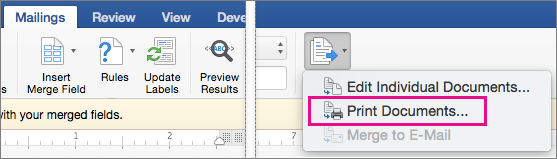
To merge directly to the printer, click Print. The Merge to printer dialog box appears, so that you can select which records to merge. Click OK. The Print dialog box appears, so that you can select your printer and print the labels.

To merge on the screen, click Edit individual labels. The Merge to new document dialog box appears, so that you can select which records to merge. Click OK to merge the labels. You can view the labels before you print them.
2.After the merged document appears on the screen, you can save it as a separate document, you can print the merged document by clicking Print on the File menu, or you can do both.

Back to the top

REFERENCES

For more information about mail merge, click the following article number to view the article in the Microsoft Knowledge Base:
290408 (http://support.microsoft.com/kb/290408/) Frequently asked questions about mail merge in Word 2002
For more information about how to create a new data source, click the following article number to view the article in the Microsoft Knowledge Base:
294688 (http://support.microsoft.com/kb/294688/) How to design and set up a mail merge address list in Word 2002 and in later versions of Word
For more information about mail merge, click Microsoft Word Help on the Help menu, type mail merge in the Search for box in the Assistance pane, and then click Start searching to view the topic.

Back to the top


APPLIES TO
Microsoft Office Word 2007
Microsoft Office Word 2003
Microsoft Word 2002 Standard Edition

Back to the top

Keywords: 
kbfaq kbhowtomaster kbmerge KB294684

Back to the top

Article Translations


Related Support Centers

Other Support Options

  • Contact Microsoft
    Phone Numbers, Support Options and Pricing, Online Help, and more.
  • Customer Service
    For non-technical assistance with product purchases, subscriptions, online services, events, training courses, corporate sales, piracy issues, and more.
  • Newsgroups
    Pose a question to other users. Discussion groups and Forums about specific Microsoft products, technologies, and services.