Important This article contains information that shows you how to lower security settings or how to turn off security features on a computer. You can make these changes to work around a specific problem. Before you make these changes, we recommend that you evaluate the risks that are associated with implementing this workaround in your particular environment. If you implement this workaround, take any appropriate additional steps to help protect the computer.
Summary
This article lists common methods to help you troubleshoot problems that you may experience when you receive or send an email message in Outlook or Outlook Express.
You should try these methods when you encounter the following errors:
Note If the common methods do not resolve your problem, you may try the additional methods listed in the table.
|
Error messages or error codes |
Additional methods |
|---|---|
|
No connection could be made because the target machine actively refused it. |
|
|
The server could not be found. (Account:account name, POPserver:'mail', Error Number: 0x800ccc0d). |
|
|
Task 'server name - Sending and Receiving' reported error (0x800ccc0f): 'The connection to the server was interrupted. If this problem continues, contact the server administrator or Internet service provider (ISP). The server responded: ? K'. |
|
|
Your server has unexpectedly terminated the connection. Possible causes of this include server problems, network problems, or a long period of inactivity. Account. account name, Server: 'server name', Protocol: POP3, Server Response: '+OK', Port: 110, Secure(SSL): No, Error Number: 0x800ccc0f. |
|
|
Task 'SMTP server name - Sending and Receiving' reported error (0x80042109): 'Outlook is unable to connect to your outgoing (SMTP) e-mail server. If you continue to receive this message, contact the server administrator or Internet service provider (ISP).' |
|
|
The operation timed out waiting for a response from the receiving (POP) server 0x8004210a. |
|
|
A time-out occurred while communicating with the server 0x800ccc19. |
|
|
Error codes: 0x800ccc15; 0x80042108; 0x800ccc0e; 0x800ccc0b; 0x800ccc79; 0x800ccc67; 0x80040900; 0x800ccc81; 0x80040119; 0x80040600. |
|
|
Error code: 0x8007000c |
|
|
Error code: 0x800C013b |
|
|
Error code: 0x8004210b |
Resolution
To resolve this issue, use one or more of the following methods. After you complete each method, send yourself a test email message to make sure that you can send and receive messages without receiving an error message. If you continue to receive errors, try the next method.
To do this, follow these steps:
-
Start an Internet browser. For example, start Internet Explorer.
-
Type one of the following addresses in the address bar, and then press Enter.
-
http://www.microsoft.com
-
http://www.msn.com
If you continue to experience Internet connectivity issues, see troubleshoot network connectivity problems in Internet Explorer.
-
See the following articles in the Microsoft Knowledge Base, as appropriate, to check your Outlook email account settings:
How to set up an Internet email account in Outlook 2013 or 2016
How to set up an Internet email account in Outlook 2010
How to set up Internet email accounts in Outlook 2007 or 2003
Suspicious email messages may block your receiving error message in Outlook. If you have any suspicious email message, delete them by using one of the following methods:
-
Access your mailbox by using your ISP's web-based email program. Then, delete the email messages.
-
Contact your ISP and ask them to delete the email messages.
If your antivirus software includes an email-scanning feature, you may have to perform additional configuration tasks to use Outlook or Outlook Express together with the antivirus software. For example, you may have to configure the Norton AntiVirus Office plug-in to work with Outlook.
For more information about how to use Outlook together with your antivirus software, go to one of the following websites, as appropriate for the antivirus software that you have installed:
Warning This workaround may make a computer or a network more vulnerable to attack by malicious users or by malicious software such as viruses. We do not recommend this workaround but are providing this information so that you can implement this workaround at your own discretion. Use this workaround at your own risk.
Configure your firewall software to enable the following files to access the Internet:
-
Outlook.exe (for Outlook)
-
Msimn.exe (for Outlook Express)
By default, port 25 is for outgoing access, and port 110 is for incoming access. If you are not sure about the ports, contact your ISP or system administrator.
More information for McAfee Personal Firewall and Norton Personal Firewall (Symantec)
Go to the McAfee website for instructions on how to configure McAfee Personal Firewall.
Or, you can remove and reinstall McAfee Personal Firewall. This reinstallation process will make sure that Outlook and Outlook Express have Internet access, because the process re-creates the program signature file that is used by the firewall.
If you are running Norton Personal Firewall 2002, Norton Internet Security, or Norton SystemWorks software by Symantec, contact Symantec product support for upgrade or reconfiguration instructions to resolve your problem.
Repairing your Outlook or Outlook Express may also resolve the problem.
How to repair Outlook and Outlook Express
Note If Outlook Express was removed from your computer or if the installation of Outlook Express is damaged, Outlook 2000 will not function correctly and may generate one of the error messages that are mentioned in the "More information" section.
Note The following methods are for Outlook only.
To test whether your email profile works correctly, try to create a new email profile. If you can send and receive email messages by using the newly created email profile, you should configure the new Outlook profile as the default profile.
Step 1: Locate the default Outlook data file
-
In Control Panel, click Mail.
-
In the Mail Setup - Outlook dialog box, click Show Profiles.

-
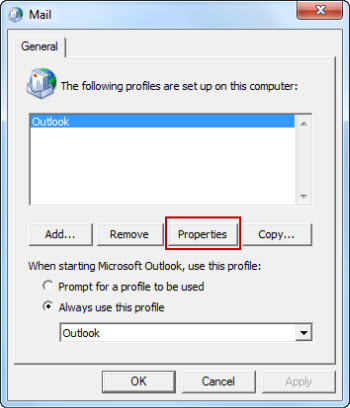
Select your current Outlook profile, and then click Properties.
-
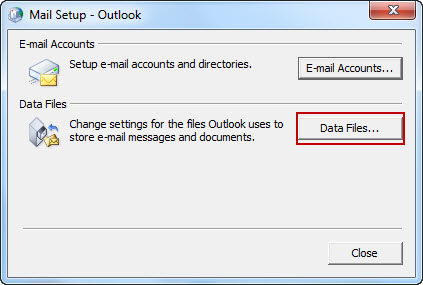
In the Mail Setup - Outlook dialog box, click Data Files.
-
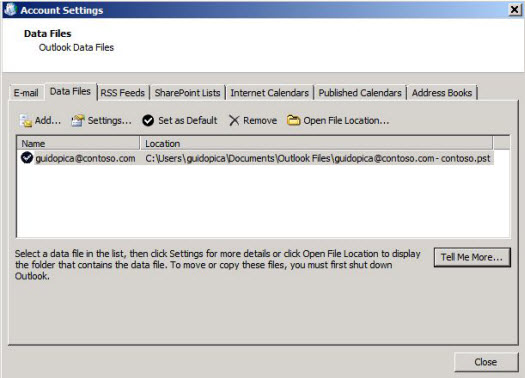
Select the Data Files tab in the Account Settings dialog box, and then note the name and location of the default data file for your profile. (A check mark will indicate the default data file.)
-
Click Close.
Step 2: Create a new Outlook profile
Now that you know the name and location of the default data file for your profile, use onlyone of the following methods to create a new Outlook profile.
Video: How to connect Outlook to your personal email account
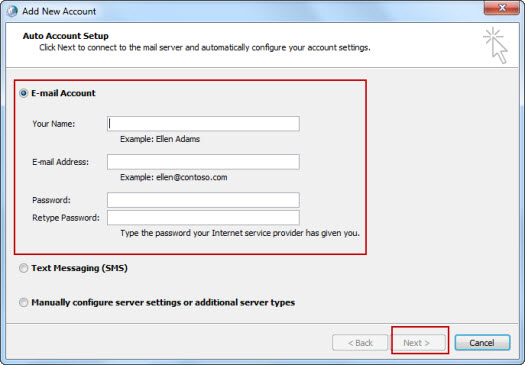
Method A: Use auto account setup to create an IMAP or POP3 email account
Important By default, auto account setup will create an IMAP account if your email server supports both IMAP and POP3. In order to create a POP3 account, you will have to follow the manual steps. However, if your email server supports only POP3, auto account setup will create a POP3 account.
-
Open Control Panel, and then click Mail.
-
In the Mail Setup - Outlook dialog box, click Show Profiles.
-
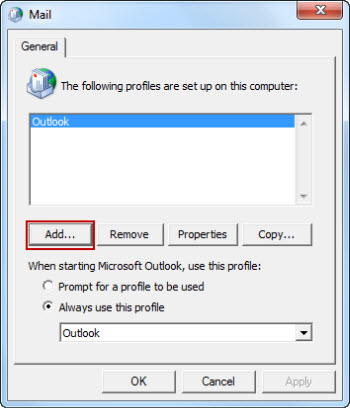
On the General tab in the Mail dialog box, click Add.
-
In the New Profile dialog box, type a new profile name, and then click OK.
-
In the Add New Account dialog box, type your email account information, and then click Next.
-
After your account is successfully configured, click Finish.
Method B: Manually create an IMAP or POP3 email account
-
Open Control Panel, and then click Mail.
-
In the Mail Setup - Outlook dialog box, click Show Profiles.
-
On the General tab in the Mail dialog box, click Add.
-
In the New Profile dialog box, type a new profile name, and then click OK.
-
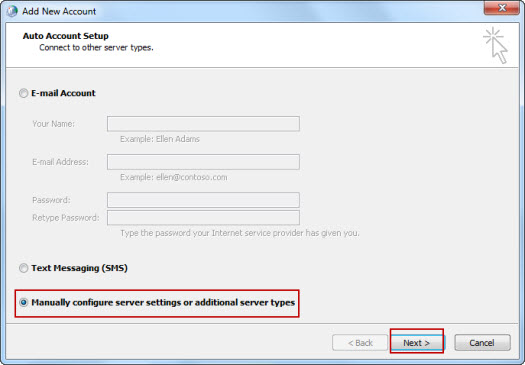
In the Add New Account dialog box, select Manually configure server settings or additional server types, and then click Next.
-
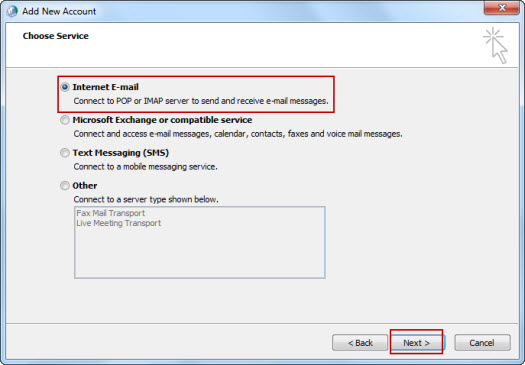
In the Choose Service dialog box, select Internet E-mail, and then click Next.
-
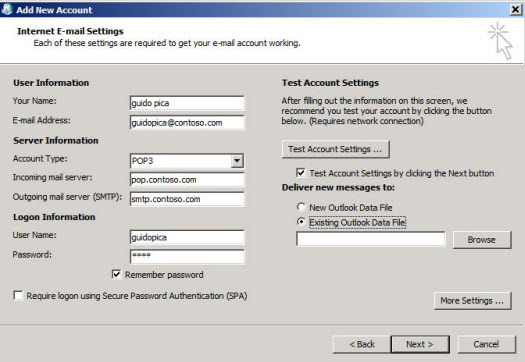
In the Internet E-mail Settings dialog box, type your account details.
-
Click Test Account Settings to test your account.
Note Contact your Internet service provider if you are unsure of the correct account details. -
Select Existing Outlook Data File, and then click Browse.
-
In the Open Outlook Data File dialog box, locate and then select the Outlook data file that you previously located, and then click OK.
-
Click Next.
-
In the Test Account Settings dialog box, click Close.
-
Click Finish.
Step 3: Configure your new Outlook profile as the default profile
If the new Outlook email profile works correctly, set the new Outlook profile as the default profile, and then move your email messages to the new profile.
-
On the General tab of the Mail dialog box, select Always use this profile.
-
Click the drop-down under Always use this profile, and then select the new profile.
-
Click OK to close the Mail dialog box.
-
Use the Import and Export wizard to export your email messages to an Outlook Data File (.pst) from your old Outlook email profile, and then import the Outlook Data File (.pst) to your new Outlook email profile.
Note If you are not familiar with the Import and Export feature in Outlook, see the following articles:How to export Outlook items to an Outlook Data File (.pst)
How to import Outlook items from an Outlook Data File (.pst)
To start Outlook in safe mode, follow these steps, as appropriate for the operating system that you have installed.
Windows 10, Windows 8.1 Windows 8, Windows 7, or Windows Vista
-
In Windows 10, select the search box in the task bar. In Windows 8.1 or Windows 8, swipe in from the right edge of the screen, and then tap Search. Or, if you are using a mouse, point to the lower-right corner of the screen, and then click Search. In Windows 7 or Windows Vista, click Start.
-
In the Search box, type outlook.exe /safe.
-
Press Enter.
Windows Server 2003, Windows 2000, or Windows XP
-
Click Start.
-
Click Run.
-
Type outlook.exe /safe.
-
Click OK.
If a notification appears that indicates that the email profile is damaged or that conflicting third-party applications or add-ins are installed, follow the steps in method 3 to create a new email profile.
A .pst file is a personal-folders file that stores your email messages, contacts, notes, calendar items, and other data. If the .pst file is corrupted, you may not be able to send or receive email messages in Outlook.
To resolve this issue, repair your Outlook personal folder file (.pst).
Click your Outbox, and then check whether there are any email messages stuck in the Outbox. If there are any messages that are stuck, follow these steps to clear those messages:
-
In Outlook, click the Send/Receive tab, and then click Work Offline.
Note This stops Outlook from trying to send all email messages. -
Select the Outbox. You can now take one of the following actions:
-
Move the message: Move the message to the Drafts folder. You can either drag the message to the Drafts folder or right-click the message, select Move, select Other Folder, and then select the Drafts folder from the list.
Note This enables you to open the large email message, and remove, resize, and then re-add the attachments before you try to resend the email message again. -
Delete the message: Right-click the message, and then select Delete.
Important If you receive the message "Outlook is transmitting the message," close Outlook, and then wait for it to exit. You may have to use Task Manager in Windows to make sure that the Outlook.exe process is complete. Restart Outlook again, and then repeat step 2. -
-
Click the Send/Receive tab, and then click Work Offline to de-select it.
More Information
Third-party products that are known to cause this problem include the following:
-
Marketscore (Netsetter) Internet Accelerator
-
Net Nanny
-
Panicware Pop-Up Stopper
If the Mapi32.dll file is damaged or incorrect, you may receive the following error message when you send or receive email messages in Outlook:
Sending and Receiving reported error (0x8007000E): Out of memory or system resources. Close some windows or programs and try again.
To resolve this issue, run the MAPI Repair Tool (Fixmapi.exe). The Fixmapi.exe file is located in one of the following folders:
-
C:\Winnt\System32
-
C:\Windows\System32
If the Sent Items.dbx file is damaged, you may receive the following error message when you sent a message in Outlook Express:
An unknown error has occurred. Protocol: SMTP, Port: 0, Secure(SSL): No, Error Number: 0x800C013B.
To resolve this issue, rename the Sent Items.dbx file from the Outlook Express email files. To do this, follow these steps:
-
Click Start, point to Find, and then click Files or Folders.
-
In the Named box, type Sent Items.dbx.
-
In the Look In box, click your primary hard disk (usually drive C), and then click Find Now.
-
Right-click the Sent Items.dbx file, and then click Rename.
-
Type Sent Items.old, and then click OK.
-
Restart Outlook Express. This action automatically creates a new Sent Items.dbx file.
If one SMTP address in a distribution list is corrupted or incorrectly formed, error 0x8004210b can occur. You should examine all email addresses in the distribution list to make sure that they are correct. Additionally, you can send individual test email messages to each distribution list member to identify invalid email addresses.
If the error message is accompanied by a time-out error message, you may be able to resolve this problem by increasing the server time-out setting in Outlook or Outlook Express. To increase the server time-out setting, use one of the following methods, as appropriate for the version of Outlook or Outlook Express that you have installed.
Outlook 2010 and later
-
Start Outlook.
-
On the Files menu, click Info.
-
Click Account Settings, and then select Account Settings from the list.
-
Click to select the target POP3 account, and then click Change.
-
Click More Settings.
-
Click the Advanced tab.
-
Gradually increase the server time-out setting until the issue is resolved.
Outlook 2007
-
Start Outlook.
-
On the Tools menu, click Account Settings.
-
Click to select the target POP3 account, and then click Change.
-
Click More Settings.
-
Click the Advanced tab.
-
Gradually increase the server time-out setting until the issue is resolved.
Outlook 2003 and Outlook 2002
-
Start Outlook.
-
On the Tools menu, click E-mail Accounts.
-
Click View or change existing e-mail accounts, and then click Next.
-
Click your POP3 account, and then click Change.
-
Click More Settings.
-
Click the Advanced tab.
-
Gradually increase the server time-out setting until the issue is resolved.
Outlook 2000 Corporate or Workgroup mode (CW)
-
Start Outlook.
-
On the Tools menu, click Services.
-
On the Services tab, click Internet E-mail, and then click Properties.
-
Click the Advanced tab.
-
Gradually increase the server time-out setting until the problem is resolved.
Outlook 2000 Internet Mail Only (IMO)
-
Start Outlook.
-
On the Tools menu, click Accounts.
-
Select the target account, and then click Properties.
-
Click the Advanced tab.
-
Gradually increase the server time-out setting until the problem is resolved.
Outlook Express 6.0 and 5.x
-
Start Outlook Express.
-
On the Tools menu, click Accounts.
-
Click the Mail tab.
-
Click your POP3 account, and then click Properties.
-
Click the Advanced tab.
-
Gradually increase the server time-out setting until the problem is resolved.
Microsoft provides third-party contact information to help you find technical support. This contact information may change without notice. Microsoft does not guarantee the accuracy of this third-party contact information.
The third-party products that this article discusses are manufactured by companies that are independent of Microsoft. Microsoft makes no warranty, implied or otherwise, about the performance or reliability of these products.