There are several reasons why you might want to import Outlook items from an Outlook Data File (.pst).
- You want to move Outlook items from one email account to another email account
- You want to move Outlook items from one PC to another PC
- You want to move Outlook items from PC to Mac or Mac to PC
- You want to move Outlook items between local folders and an IMAP or Exchange server.
Select a tab option below for the version of Outlook you're using. What version of Outlook do I have?
Importing in new Outlook for Windows
You can access emails stored in a .pst data file and browse, manage, or move emails (drag and drop) between .pst files and mailboxes. You'll have the option to:
- Import items from the .pst file into a mailbox - Importing places selected items in a mailbox account and folder.
- Open or add the .pst file to access its contents without importing them - Opening a .pst file connects the local file to Outlook without copying its contents into the mailbox.
Import a data file (.pst) in new Outlook for Windows
- In new Outlook, select Settings, Data files, and then Import.
- Under Outlook Data File (.pst), select Get started, then Select file.
- Browse to the location of the .pst file, choose the file, then select Open.
- Under Folders to import from, select the folder that contains the items you want to import, then select Next.
Tip
To import the selected folder and its subfolders, leave the Include subfolders box checked.
- Under How do you want to handle duplicate items? select one of the options, then select Next.
- Under Choose a destination folder, select the mailbox from the Account list.
- In the folder list, select the folder where you want the imported items to be placed. To create a separate destination folder, select New folder, and then select the new folder as the destination.
- Select Import.
Note
Import uses the .pst file as the source and places the selected items in the destination mailbox. It does not add the source .pst file under Outlook Data Files. To keep the .pst file available as a separate data file in Outlook, follow the steps in the next section.
Open an Outlook data file (.pst) in new Outlook for Windows
- In New Outlook, select Settings, then Data files.
- Select Outlook Data Files, then Add file.
- In the file browser, locate and select the .pst file.
- Select Open.
Requirements for opening a .pst file
- Classic Outlook must also be installed.
- Classic Outlook and new Outlook must use the same architecture, either 32-bit or 64-bit.
- The account used in new Outlook must have a Microsoft 365 subscription.
- Outlook Data Files are not supported with the ARM version of new Outlook.
- New Outlook cannot be running in Safe or Recovery mode.
Import Outlook items from a .pst file in classic Outlook for Windows
These instructions assume you've already exported your Outlook email, contacts, and calendar from another instance of Outlook, and now you want to import them to Outlook.
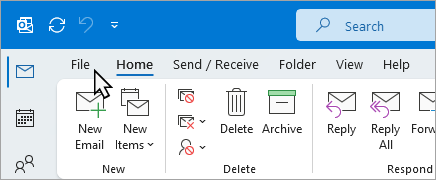
At the top of your Outlook ribbon, select File.
If your ribbon doesn't have a File option in the top left corner, you aren't using an Outlook app installed on your computer. Go to What version of Outlook do I have? to find your version of Outlook and to get to right import steps.
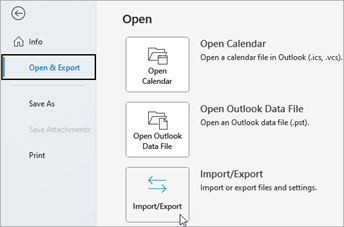
Select Open & Export > Import/Export. This starts the Import/Export wizard.
Select Import from another program or file, and then select Next.

Select Outlook Data File (.pst) and select Next.
Browse to the .pst file you want to import. Under Options, choose how you want to deal with emails and contacts, then choose Next.
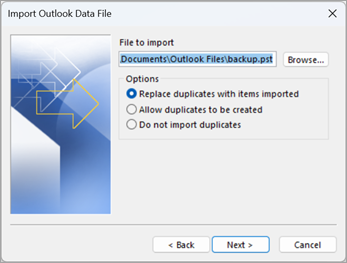
If a password was assigned to the Outlook Data File (.pst), enter the password, and then select OK.
If you're importing the contents of your .pst file into your Microsoft 365 mailbox, choose that mailbox here.
If you're NOT importing into your Microsoft 365 mailbox, choose Import items into the current folder. This imports the data into the folder currently selected.
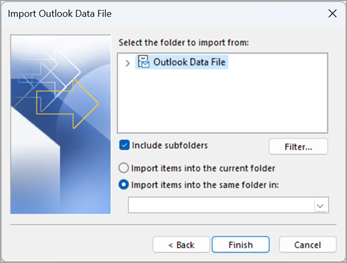
Choose Finish. Outlook starts importing the contents of your .pst file immediately. When the progress box disappears, the import is finished.
If you're importing your .pst file to your Microsoft 365 mailbox, you might get a message that it's trying to connect with Microsoft 365. This happens when the Internet connection is interrupted, even for a moment. Once your Internet connection is re-established, Outlook will continue importing the .pst file.
Tip
If you want to retrieve only a few emails or contacts from an Outlook Data File (.pst), you can open the Outlook Data File, and then, in the navigation pane, drag and drop the emails and contacts from .pst file to your existing Outlook folders.
What data is imported?
.Pst files are created when you export or back up email, contacts, and calendar to an Outlook .pst file. Outlook makes a copy of your email to the .pst file.
- When Outlook exports emails to a .pst file, it includes any attachments. So, when you import a .pst file, you'll get your attachments.
- Outlook does not export meta-data such as folder properties ( views, permissions, and AutoArchive settings); message rules; and blocked senders lists. So, they won't be imported, either.
- When Outlook exports email, contacts, and calendar info to a .pst, it makes a copy of the information. Nothing is deleted from Outlook. You'll still have access to your email, contacts, and calendar in Outlook.
Didn't work?
Go to Fix problems importing an Outlook .pst file for a list of common issues and solutions.
Related article
Import and export Outlook email, contacts, and calendar

