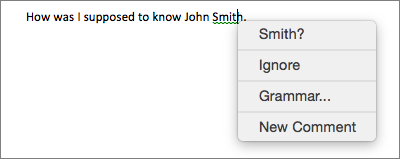
All Microsoft Office programs can check spelling, and most can check grammar.
Tip
Using Microsoft 365? You may be interested in checking out the powerful new Editor feature in Word! See Editor - your writing assistant for more information.
Run the spelling and grammar checker
To start a check of the spelling and grammar in your document, just press F7.
Select a heading below for more information
Show errors automatically while you work
Most Office programs automatically check for potential spelling and grammatical errors as you type, so you don't need to do anything to show errors while you work.
Note
- Automatic spelling and grammar checking is not available in Access, Excel, or Project. You can manually start a spell check by pressing F7.
- Automatic grammar checking is available only in Outlook, Word, and PowerPoint.
Office marks potential spelling errors with a red squiggly line, and potential grammatical errors are marked with a blue squiggly line.
If spelling or grammatical errors aren't marked, automatic checking might be turned off. You can turn on the automatic spelling and grammar checker.
When you see a spelling or grammatical error that you want assistance fixing, right-click on the underlined word or phrase and choose one of the options to fix the error.
If Office is flagging words as misspelled but you have it spelled the way you want it, select Add to Dictionary to teach Office not to flag that word as misspelled in the future. For more information on this see: Add or edit words in a spell check dictionary.
Turn the multicolored underlining on or off
If you don't want Office to mark potential errors with squiggly lines while you are working, you can turn automatic spelling and grammar checking off:
Open the spelling and grammar options:
- In OneNote, PowerPoint, Publisher, Visio, and Word: On the File menu, select Options, and choose Proofing.
- In Outlook: On the File menu, select Options, choose Mail, and then select Spelling and Autocorrect.
Select or clear the Check spelling as you type check box. In programs that have automatic grammar checking, you may also select or clear the Mark grammar errors as you type check box.

Note
In Word, you can turn the spelling checker on or off for only the document you're currently working with or for all new documents. Select an option in the Exceptions for list, and then select or clear the Hide spelling errors in this document only and Hide grammar errors in this document only check boxes.
Turn grammar checking off entirely
If you don't want Office to check grammar at all (either when running a spell check or automatically as you type), you can turn it off:
Open the spelling and grammar options:
- In OneNote, PowerPoint, Publisher, Visio, and Word: On the File menu, select Options, and choose Proofing.
- In Outlook: On the File menu, select Options, choose Mail, and then select Spelling and Autocorrect.
Clear the Mark grammar errors as you type and Check grammar with spelling check boxes.

Note
Not every Office program will have both of these options.
Recheck spelling and grammar that you previously ignored
In Word, Outlook, PowerPoint, you can force a recheck of the words and grammar that you previously skipped by doing the following:
- Open the document or item that you want to check.
- On the File menu, select Options.
- Select Proofing and choose Recheck Document. In Outlook you'll find this under Mail and select Spelling and Autocorrect
- Select Yes when you see the warning message about resetting the spelling and grammar checker.
- Select OK in the dialog box to get back to the document, and then run the spelling and grammar checker again.
See Also
Check spelling and grammar in a different language.
Test your document's readability
The spelling and grammar checker isn't working as expected
Add words to your spell check dictionary
The spelling or grammar checker isn't checking words in a different language correctly
Choose AutoCorrect options for capitalization, spelling, and symbols
Check spelling before sending a message in Outlook
Learn how to get more from Editor with Microsoft 365
Office for Mac applications automatically check for potential spelling and grammatical errors as you type. If you'd rather wait to check spelling and grammar until you're done writing, you can turn off automatic checking, or you can check spelling and grammar all at once.
Word
Check spelling and grammar automatically as you type
Word marks potential spelling errors with a red squiggly line, and potential grammatical errors are marked with a green squiggly line.
Tip
If spelling or grammatical errors aren't marked, you might need to turn on automatic spelling and grammar checking, which is explained in the next procedure.
When you see a spelling or grammatical error, Control-click the word or phrase and choose one of the options.
If Word has incorrectly flagged a word as misspelled and you want to add that word to your dictionary so that Word will properly recognize it in the future see Add or edit words in a spell check dictionary
Turn automatic spelling and grammar checking on or off
- On the Word menu, select Preferences and choose Spelling & Grammar.
- In the Spelling & Grammar dialog box, under Spelling, check or clear Check spelling as you type.
- Under Grammar, check or clear Check grammar as you type.
- Close the dialog box to save your changes.
Check spelling and grammar all at once
On the Review tab, select Spelling & Grammar.
If Word finds a potential error, the editor opens and spelling errors are shown as red text, and grammatical errors show as green text.
To fix an error:
- Under Suggestions, choose the word you want to use, and then select Change.
To skip the error, do one of the following:
- Select Ignore once to skip only that instance of the error.
- Select Ignore All to skip all instances of the error.
- For a grammatical error, select Next Sentence to skip that instance of the error and move to the next error.
To skip a misspelled word in all documents, select Add to dictionary to add it to the dictionary. This only works for misspelled words. You can't add custom grammar to the dictionary.
After you correct, ignore, or skip an error, Word moves to the next one. When Word finishes reviewing the document, you'll see a message that the spelling and grammar check is complete.
Recheck the spelling and grammar that you previously checked and chose to ignore
You can clear or reset the list of Ignored Words and Grammar so Word will check for spelling and grammar issues you previously told it to ignore.
Note
When you reset the list of Ignored Words and Grammar, the list is cleared only for the currently open document. Any spelling or grammar issues you told Word to ignore in other documents won't be affected.
- Open the document that needs to be checked.
- On the Tools menu, point to Spelling and Grammar, and then select Reset Ignored Words and Grammar.
Word displays a warning that resetting the spelling checker and the grammar checker causes words that were previously ignored to be rechecked for spelling and grammar.
- Select Yes to proceed.
- Select the Review tab, and then choose Spelling & Grammar to check spelling and grammar.
Outlook
Check spelling and grammar automatically as you type
By default, Outlook checks for spelling errors as you type. Outlook uses a dashed red underline to indicate possible spelling errors and a dashed green line to indicate possible grammatical errors.
When you see a word with a dashed underline, control+click the word or phrase and choose one of the options.
Correct the error in your message or on the shortcut menu, do one of the following:
- Select one of the guesses at the top of the shortcut menu.
- Select Ignore All to ignore all instances of the word.
- Select Add to Dictionary to add the word to the spelling dictionary.
Turn automatic spelling and grammar checking on or off
After opening an email message. on the Outlook menu, select Settings, choose Spelling and Grammar.
Do one of the following
- To correct spelling mistakes automatically, select or clear Check spelling as you type.
- To turn automatic grammar checking on or off, select or clear Check grammar as you type.
Check spelling and grammar all at once
You can correct all the spelling and grammar issues at the same time after you finish composing a message or other items.
On the Edit menu, point to Spelling and Grammar, and then select Spelling and Grammar.
Correct the error in your message or in the Editor, do any of the following:
- In the list of suggestions, choose the word that you want to use.
- Select Ignore once to ignore this word and move on to the next misspelled word.
- Select Ignore all to ignore all instances of the word.
- Select Add to dictionary to add the word to the spelling dictionary.
Tip
The keyboard shortcut for skipping to the next spelling or grammar error is ⌘+ ; (semi-colon).
PowerPoint
You can check spelling in PowerPoint, but you can't check grammar.
Check spelling automatically as you type
PowerPoint automatically checks for and marks potential spelling errors with a wavy, red underline.
Tip
If spelling errors aren't marked, you might need to turn on automatic spell checking, which is explained in the next procedure.
When you see a spelling error, control+click the word or phrase and choose one of the suggested options.
Turn automatic spell checking on or off
- On the PowerPoint menu, select Preferences and choose Proofing.
- In the Proofing dialog box, select or clear Check spelling as you type.
Check spelling all at once
On the Review tab, select Spelling.
If PowerPoint finds a potential error, the Spelling pane opens and spelling errors are shown.
To fix an error, do one of the following:
- Correct the error on your slide.
- Choose one of the suggested words in the Spelling pane, and then select Change.
To skip the error, do one of the following:
- Select Ignore to skip only that instance of the error.
- Select Ignore All to skip all instances of the error.
- Select Add to skip a misspelled word in all documents and add it to the dictionary.
After you correct, ignore, or skip an error, PowerPoint moves to the next one. When PowerPoint finishes reviewing the presentation, you'll see a message that the spelling check is complete.
Select OK to return to your presentation.
Excel
You can check spelling in Excel, but you can't check grammar.
Check spelling all at once
On the Review tab, select Spelling.
Note
The Spelling dialog box will not open if no spelling errors are detected, or if the word you are trying to add already exists in the dictionary.
Do any of the following.
| To |
Do this |
| Change the word |
Under Suggestions, choose the word that you want to use, and then select Change. |
| Change every occurrence of this word in this document |
Under Suggestions, choose the word that you want to use, and then select Change All. |
| Ignore this word and move on to the next misspelled word |
Select Ignore Once. |
| Ignore every occurrence of this word in this document and move on to the next misspelled word |
Select Ignore All. |
See also
Check spelling and grammar in a different language