
The Study and Learn Agent provides a scaffolded chat experience with multiple learning features. Here is an overview of each feature and how to use it effectively.
Scaffolded Learning Conversations
The core experience of the Study and Learn Agent is an adaptive, scaffolded conversation that meets you where you are and builds understanding step by step. Unlike a traditional chatbot that simply answers your questions, the Study and Learn Agent is designed around a core principle: the learner does the thinking.
How it works:
Starts with what you know: The agent begins by asking what you already know about a topic, then builds from there. This activates your prior knowledge and helps the agent calibrate its responses to your level giving every learner a personalized experience.
Breaks topics into steps: Rather than presenting a wall of information, the agent introduces concepts one at a time, checking your understanding along the way. Each step builds on the last.
Adapts to different learning intents: The agent adjusts its approach based on what you're trying to learn:
Broad concepts (for example, "What is angular momentum?"): Breaks the topic into sub-concepts, uses a variety of explanation formats including analogies, examples, and comparisons.
Step-by-step problems (for example, "Solve 4(2x−3)=28"): Guides you through the problem-solving process, helping you check your own answer rather than solving it for you.
Explains in different ways: When something isn't clicking, the agent tries a different approach — an analogy, a worked example, a comparison, or a simpler re-explanation. The goal is for you to understand, not just to hear the answer.
Always leads with questions: The agent asks questions throughout the conversation to keep you actively thinking. It guides you toward the answer with hints and sub-questions instead of just giving it away. When you're struggling, it offers a simpler question to get you back on track. When you're ready, it increases the challenge.
Your files as context: If you've uploaded documents, slides, PDFs, or other materials, the agent uses them as grounding context. Citations appear throughout the conversation so you can verify information against your original sources.
How to use scaffolded conversations: Start by asking about a topic or uploading your study materials. Engage with the agent's questions — try to answer before asking for the answer. When the agent asks "what do you think?" or "can you try?", take a moment to think through your response. This active engagement is what makes learning stick. If you get stuck, the agent will provide hints and progressively more support. You can always ask for clarification or to see the concept explained a different way.
Writing Support
The Study and Learn Agent helps students develop their writing skills — without doing the writing for them. When you bring a writing task (for example, "Help me with my essay on Reconstruction"), the agent coaches you through the stages of the writing process: brainstorming, organizing, drafting, and revising.
How it works:
Draws out your ideas: The agent asks questions to help you clarify what you want to say before you start writing. It helps you identify your argument, find supporting evidence, and organize your thoughts.
Coaches on knowledge gaps: If the agent identifies areas where your understanding is thin, it helps you build that knowledge before incorporating it into your writing. This ensures your writing reflects genuine understanding.
Guides the writing process: The agent walks you through brainstorming, outlining, drafting, and revising. At each stage, it asks questions that sharpen your thinking and improve your work.
Never writes for you: The agent will not generate essay text, paragraphs, or complete sentences for you. Its role is to coach — building lasting writing judgment and critical thinking, not just producing a better draft.
How to use writing support: Start by telling the agent what you're working on and what stage you're at. If you're stuck on getting started, the agent can help with brainstorming. If you have a draft, it can help you identify areas to strengthen. Be open to the questions it asks — they're designed to make your writing better by making your thinking sharper.
Images in Learning
The Study and Learn Agent weaves web-searched images into explanations to help you visualize concepts. Diagrams, charts, visual aids, and real-world photos appear alongside text explanations where they add learning value — not as decoration, but as genuine learning tools.
How it works:
Curated from reliable sources: Images are drawn from web sources with citations provided, so you know where each visual came from.
Used when appropriate: The agent includes images when they genuinely support understanding — for example, a diagram of cell structure in biology, a map in geography, a molecular diagram in chemistry, or a geometric figure in math.
Reduces cognitive load: Visual aids help you build a mental model without having to construct the visual in your head while processing new concepts. This is especially powerful for spatial and visual subjects.
How to use images: Images appear naturally in the flow of conversation when they're relevant. You can also ask the agent to "show me a diagram of..." or "can you find an image that illustrates..." to request visual support for specific concepts.
Flashcards
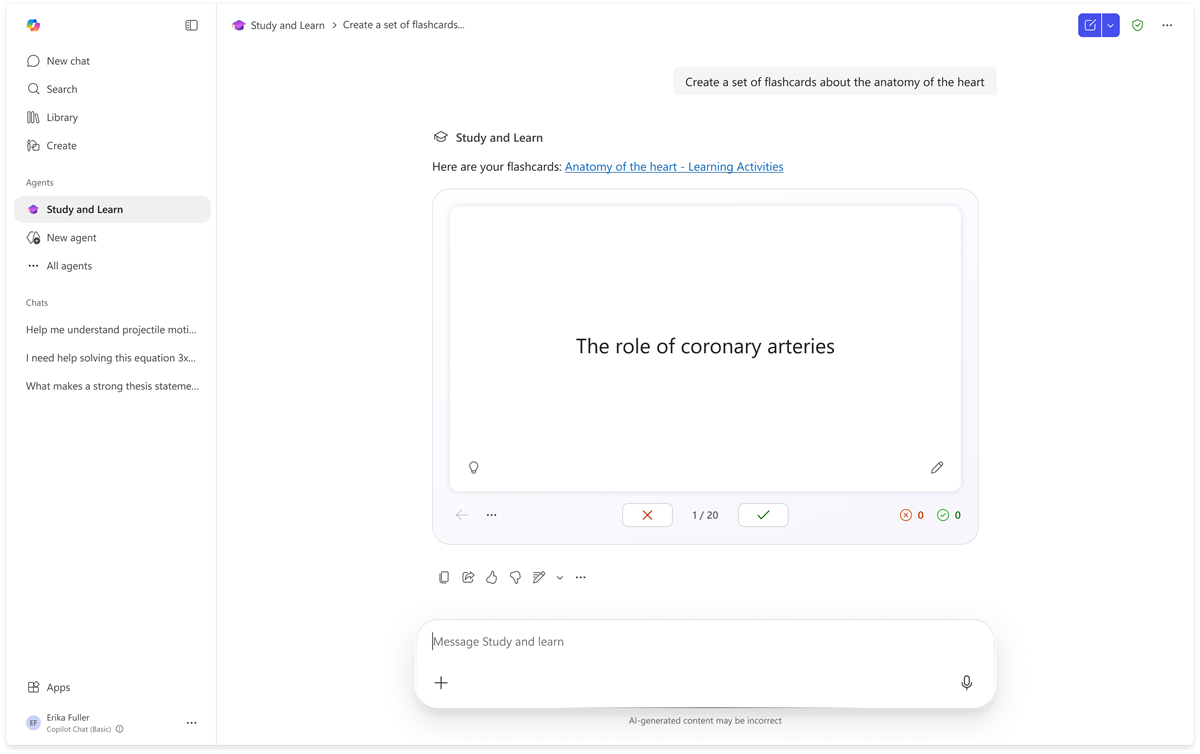
Flashcards are a proven technique for active recall — the process of trying to retrieve information from memory, which strengthens learning far more than re-reading notes. The Study and Learn Agent generates flashcards based on your own materials or any topic you're studying.
How it works:
Generated from your content: Flashcards are created from the key facts, definitions, and concepts in your uploaded materials or from the topic you're discussing. They're specific to what you're studying — not generic internet flashcards.
Interactive Q&A format: Each flashcard presents a question or term on one side. Try to recall the answer before revealing it. For example, a flashcard might ask "What is the function of the heart valves?" and the answer would be "To prevent blood from flowing backward, ensuring one-way circulation."
Contextual hints: If you're stuck on a card, you can request a hint before revealing the answer. Hints are scaffolded — they nudge you toward the answer without giving it away.
Remediation built in: After going through a set of flashcards, the agent helps you work on the ones you missed. It re-teaches the concepts behind incorrect answers and lets you retry until you feel confident. You can redo just the ones you missed or the entire set. You can also shuffle the cards so you don’t just recall from memory of your last round.
How to use flashcards: Ask the agent to "create flashcards" about what you're studying, or the agent may suggest them after a learning conversation. Work through each card by trying to recall the answer before flipping. Mark the ones you struggle with and come back to them. Incorporate flashcards into a regular study routine for spaced repetition — practicing every few days strengthens long-term memory.
Quizzes
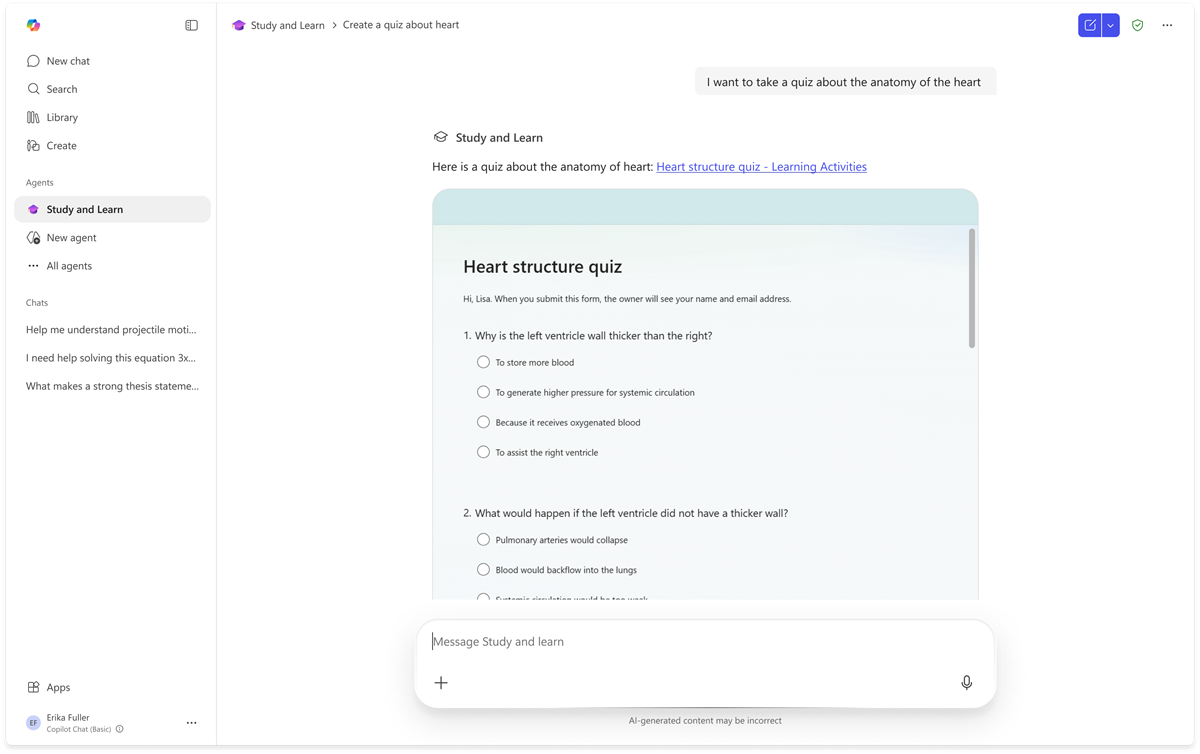
The Study and Learn Agent generates quizzes to help you test your understanding of the material you're studying. Quizzes provide immediate, specific feedback on every answer. Quiz scores simply highlight what you got right and wrong; they aren't meant to predict the score you might get on an actual class test. Your quiz scores are private and visible only to you, not your educator or anyone else.
How it works:
Generated from your content: Quizzes are created from your uploaded materials or from the topic you're exploring. Questions are always relevant to what you're actually studying.
Multiple question formats: Quizzes may include multiple-choice, short answer, and other question types covering the key concepts from your study session.
Per-answer explanations: After you answer each question, the agent provides a targeted explanation — reinforcing correct answers and explaining why incorrect answers are wrong. This feedback loop is far more effective than simply seeing a score.
Supports the testing effect: The act of trying to recall answers during a quiz strengthens your memory far more than re-reading notes. Taking quizzes is itself a powerful study technique.
Privacy of results: Quiz results are completely private. They are not sent to an instructor, stored in a gradebook, or shared with anyone. The quiz is solely for your self-assessment — a safe space to make mistakes and learn from them.
How to use quizzes: Ask the agent to "quiz me" or "test my understanding" on what you've been studying. Answer each question thoughtfully before submitting. Review the explanations carefully, especially for questions you got wrong — then go back and study those concepts further. You can retake quizzes as many times as you like.
Matching
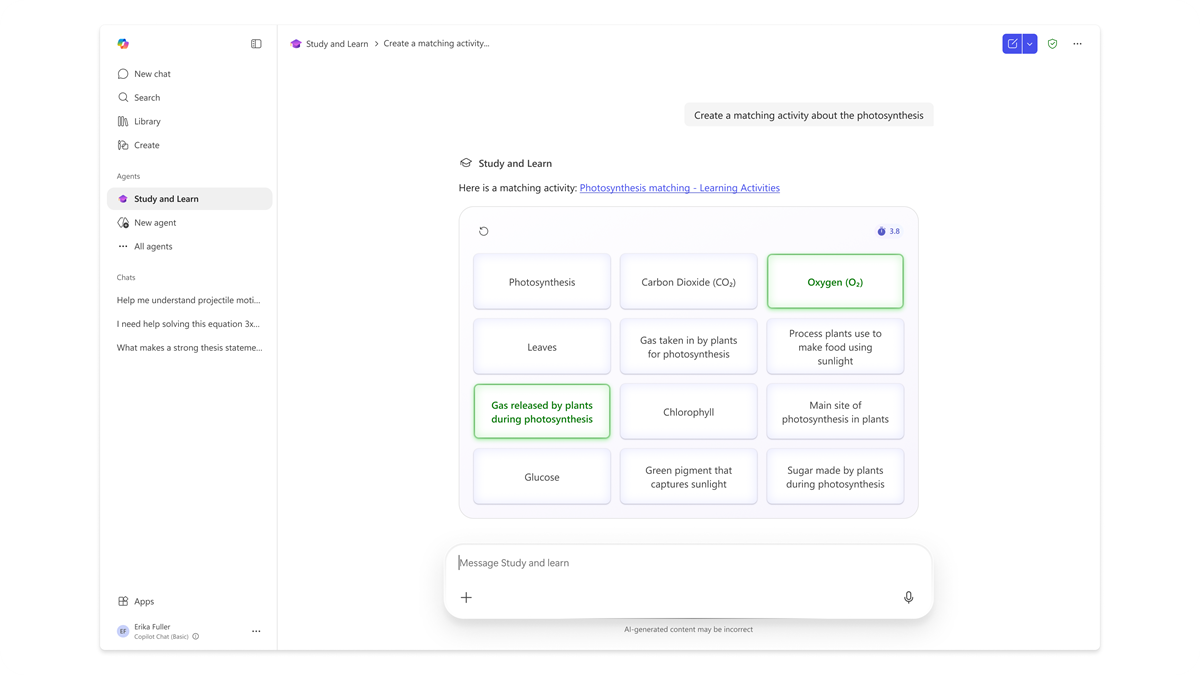
The Matching activity tests your ability to connect related concepts by pairing items.
How it works:
Concept connections: Some cards might contain terms, concepts, or questions, while the other contains definitions, explanations, or answers. For example, matching anatomical structures to their functions, or historical events to their dates.
Active recall and association: Matching reinforces your ability to form connections between related ideas — a key element of deep understanding.
Works with any subject: Biology terms, history timelines, physics formulas, language vocabulary, or any content where relationships between concepts matter.
How to use matching: Ask the agent to "create a matching activity" or it may suggest one during your study session. Work through each pair, trying to make the connection from memory before checking. Matching is especially effective as a quick review exercise to reinforce associations you've been learning.
Fill in the Blanks
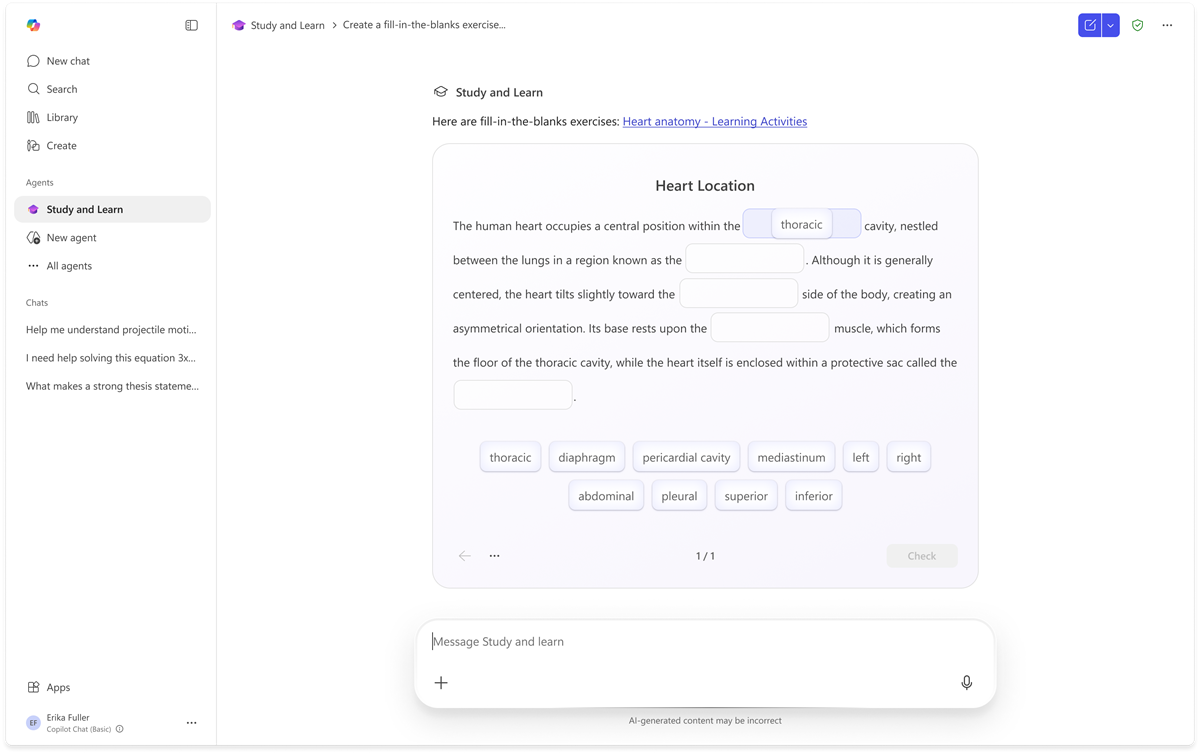
The Fill in the Blanks activity tests your recall of specific terms and facts by presenting key sentences with critical words removed.
How it works:
Drawn from key concepts: Sentences come from the important ideas in your study materials, with essential terms or phrases blanked out. For example: "The ____ is the powerhouse of the cell" (answer: mitochondria).
Reinforces specific recall: This activity complements the broader understanding tested by quizzes and the rapid recall tested by flashcards. It's especially effective for subjects with important process ideas that explain how things work or cover a sequence of events.
Contextual hints: If you're stuck, you can request hints that point you in the right direction without giving the answer away.
How to use fill in the blanks: Ask the agent to "create a fill-in-the-blanks activity" or it may offer one as part of your study session. Work through each blank, trying to recall the exact term. This is especially useful after reviewing topic explanations to check whether you can recall specific terminology and factual details.
Remediation — Help With What You Missed
One of the most powerful features of the Study and Learn Agent is built-in remediation across all learning activities. When you get something wrong, the agent doesn't just mark it incorrect — it helps you learn from the mistake.
How it works:
Targeted re-teaching: When you miss a flashcard, quiz question, matching pair, or fill-in-the-blank, you can ask the agent to help you learn it and identifies the concept behind the error and helps you understand it before moving on.
Mistakes as learning opportunities: The agent treats errors as valuable — a natural part of learning. Feedback is specific to what you did, not generic. It helps you figure out why something was wrong and how to think about it differently.
Redo what you missed: After any activity, you can choose to redo just the items you got wrong, or redo the entire set. The agent tracks your progress and encourages you to work through difficult items until you feel confident.
Scaffolded support: If you continue to struggle with a concept, the agent provides progressively more support — hints, alternative explanations, worked examples — until the concept clicks.
How to use remediation: After completing any learning activity, review your results. For items you missed, let the agent walk you through the concept again. Then retry those items. This cycle of attempt → feedback → re-learn → retry is one of the most effective study techniques in learning science.