

Not every task in a workflow or content process should be automated—even if Microsoft Copilot can do it. Delegating work to AI doesn't transfer accountability. When you automate a task or part of a workflow, you remain responsible for reviewing, validating, and approving how the work is used—and for the accuracy, tone, and impact of the final content.
This article introduces a practical decision framework you can use across different types of work—including project workflows, sales activities, operations processes, and knowledge work. It helps you determine which tasks to delegate to Copilot or an agent—and which should remain human-led or require human review before use. It also highlights trade-offs and provides examples to support your judgment.
Think of AI as a collaborator you manage
Copilot and agents work best when you treat them like capable—but unsupervised—collaborators whose outputs require human direction or validation before they’re shared or acted on. This applies whether you're building a project plan, drafting a sales proposal, analyzing operational data, or summarizing research.
How the collaboration works: You set direction and boundaries → AI drafts, summarizes, and analyzes → You review, refine, and approve the result before it’s used.
Agents expand what you can do, not what you are responsible for. The key question is not “Can AI do this?” but “Where should AI support the work—and where should humans lead or review before decisions are made?”
How do I evaluate a task before deciding to use AI?
Before automating a task or any part of a project workflow, pause to evaluate the work itself. Most workflows are made up of smaller steps that vary in risk, ambiguity, and judgment.
Breaking the work into subtasks shows where an agent could support execution—but deciding where to draw the line is a judgment call. Delegating too much can introduce risk or erode trust. Delegating too little can limit the value of automation.
To make that call, assess each task using the same four criteria: Repeatability, Impact, Error detectability, and Time sensitivity.
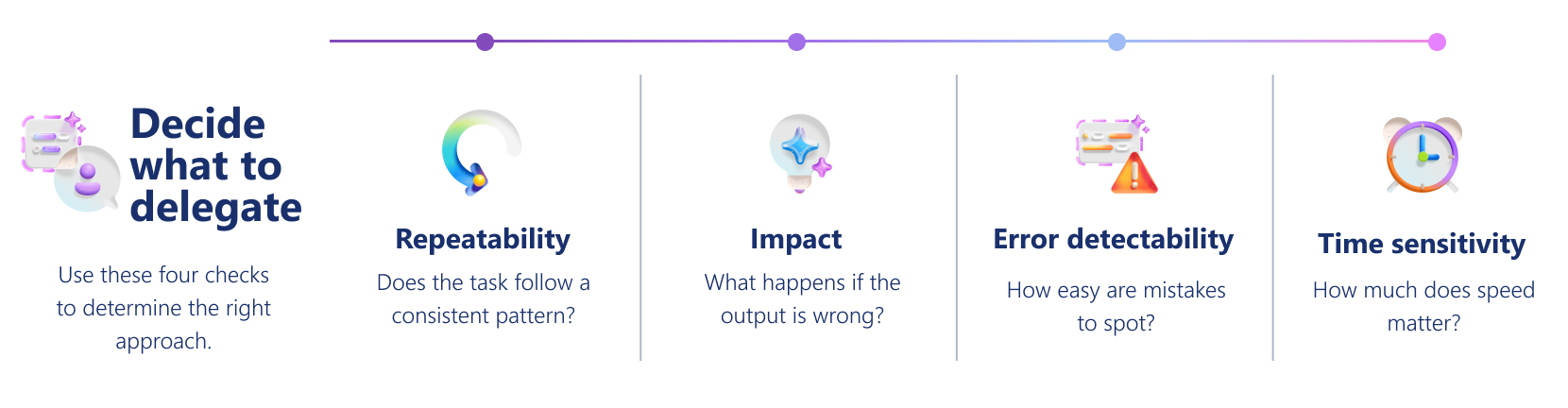
Applying these criteria consistently helps you decide which steps to:
- Automate with human review
- Support with Copilot but keep human-led
- Keep fully human-led
These outcomes reflect increasing levels of human ownership—from reviewing AI output to leading or fully owning the work.
Repeatability
Does the task follow the same pattern each time?
Highly repeatable tasks—such as generating a weekly status update, creating a recurring sales summary, or producing a standard operations report—are strong candidates for automation with a quick human review before sharing.
Tasks that are unique, exploratory, or highly variable—such as developing a deal strategy, defining a business process, or writing original thought leadership content—usually require more human-led execution.
Impact
What happens if the output is wrong?
Low‑risk tasks, like drafting a first version of an internal update or summarizing meeting notes, are easier to delegate for AI‑generated drafting followed by human review.
High‑risk tasks—such as approving budget, sending customer-facing proposals, or publishing external communications—typically require human‑led ownership, even if AI assists with preparation.
Error detectability
How easy is it to spot and correct mistakes?
Automation is safer when errors are obvious and easy to verify, such as scanning a summary against known facts or cross-checking numbers in a report against the original source.
If errors could be subtle or hidden—like incorrect formulas in a spreadsheet, misinterpreted customer insights, or inaccurate analysis in a research summary—human‑led validation or manual handling might be necessary before the output is trusted or reused.
Time sensitivity
How much does speed matter?
Automation can dramatically reduce turnaround time for frequent or time‑bound tasks, such as responding to internal requests, updating dashboards, or drafting routine communications.
However, if a task is so time‑sensitive that there is no opportunity for review, you might choose to keep it human-led to ensure accuracy and appropriate judgment.
How do I balance speed with oversight when automating work?
Automation always involves a trade‑off between efficiency and control.
- More automation increases speed and consistency, but still requires human review before outputs are finalized or shared.
- More oversight increases confidence and accountability, but takes more time.
In many cases, a hybrid approach works best. For example:
- A project manager reviews an AI-generated status report.
- A sales rep refines an AI-drafted customer proposal.
- An operations lead validates an AI-generated performance summary.
This keeps humans in the loop while preserving speed and maintaining quality.
Where does automation work well—and where should humans stay in the lead?
The following examples illustrate common patterns—not prescriptions. Your decision should reflect your context, risk tolerance, and accountability.
Tasks to automate with human review
| Task type | Example | Recommended approach |
|---|---|---|
| Routine, repeatable work | Creating recurring status reports or summaries from known data sources | Copilot or agents generate outputs; humans review before sharing |
| Drafting standard content | Drafting outlines or first versions of standard documents | Copilot drafts content; humans review and refine |
| Aggregating structured information | Aggregating information from multiple files or trackers | Copilot gathers and synthesizes content; humans validate key details |
| Automating routine actions | Sending routine reminders or notifications | Agents automate actions; humans monitor outcomes as needed |
Tasks suited for Copilot support with human-led work
| Task type | Example | Recommended approach |
|---|---|---|
| Judgment-heavy work with structured inputs | Prioritizing tasks using known criteria | Humans lead decisions; Copilot organizes inputs and suggests options |
| Drafting with clear ownership | Preparing stakeholder updates or internal messaging | Humans shape message; Copilot drafts and refines |
| Exploratory analysis with guidance | Reviewing trends or summarizing performance data | Humans guide analysis; Copilot surfaces patterns |
Tasks that should remain fully human-led
| Task type | Example | Recommended approach |
|---|---|---|
| Final approvals and accountability | Approving budgets or commitments | Humans lead; no delegation of decision authority |
| High-risk or sensitive communication | External communications with legal or reputational risk | Humans write, review, and approve |
| Ambiguous or evolving work | Defining unclear goals or resolving complex trade-offs | Humans lead entirely; AI use is limited or avoided |
Even when tasks repeat, work that relies on judgment, nuance, or accountability usually benefits from keeping humans in the lead, with Copilot or agents supporting clearly defined steps.
Use Copilot to evaluate whether AI is the right tool
You can use Copilot to help assess whether a task should be automated, supported, or kept fully human-led by evaluating the task across four criteria—repeatability, impact, error detectability, and time sensitivity. These prompts work across roles—whether you're managing projects, closing deals, improving operations, or creating content.
Repeatability
 This task is: [describe task]. How repeatable is it? Does it follow a consistent pattern that could be automated, or does it vary significantly each time?
 |
|---|
Impact
|
What are the potential risks if this task is automated and the output is incorrect or incomplete? Classify the level of impact. |
|---|
Error detectability
|
If errors occurred in this task, how easy would they be to detect and correct? Identify any risks that might be difficult to verify. |
|---|
Time sensitivity
|
How important is speed for this task? Would automation meaningfully improve turnaround time without reducing necessary oversight? |
|---|
Compare approaches and get recommendations
Use Copilot to evaluate tradeoffs directly
|
Compare the tradeoffs between automating this task with human review, supporting it with Copilot while keeping it human-led, and keeping it fully human-led. Consider speed, risk, accuracy, and accountability. |
|---|
Use Copilot to get a recommendation with reasoning
|
Based on repeatability, impact, error detectability, and time sensitivity, recommend whether this task should be automated with human review, supported by Copilot with human leadership, or handled fully by a human. Explain your reasoning. |
|---|
What questions should I ask before using AI for this task?
When you’re unsure, pause and validate your choice:
- Can Copilot clearly understand the task using available data and instructions?
- What is the worst‑case impact if the output is wrong?
- How much time would automation realistically save?
- Who will review or validate the output before it’s used or shared?
- Can you easily verify the result before it’s used or shared?
If verification is difficult, consider partial automation or keeping the task human-led with AI support for drafting or preparation.
Quick readiness checklist
Before deciding to use Copilot or an agent, confirm:
✔️ Repeatability: The task follows a consistent pattern that AI can reliably handle.
✔️ Impact: The impact of errors is understood and acceptable with appropriate human review.
✔️ Error detectability: Mistakes would be visible and easy to verify or correct.
✔️ Time sensitivity: Speed provides real value without reducing necessary oversight.
If any of these are unclear, reassess the task before deciding how to proceed.
Accountability stays with you
Work produced by Copilot or an agent is still your work. Maintaining accountability doesn't mean avoiding automation—it means keeping humans appropriately involved in reviewing or leading work based on its risk and impact.
As you apply this framework across different types of work—projects, sales, operations, or content—you’ll refine where AI adds the most value and where human judgment matters most.
As you gain experience, you might adjust what you delegate and how much oversight you apply. Thoughtful decisions about automation help you benefit from Copilot’s speed while protecting the quality and reliability of your work outcomes.
Tip
Download the Decide when Copilot or an agent is the right tool for your workquick reference guide, a practical resource you can revisit as you work.