
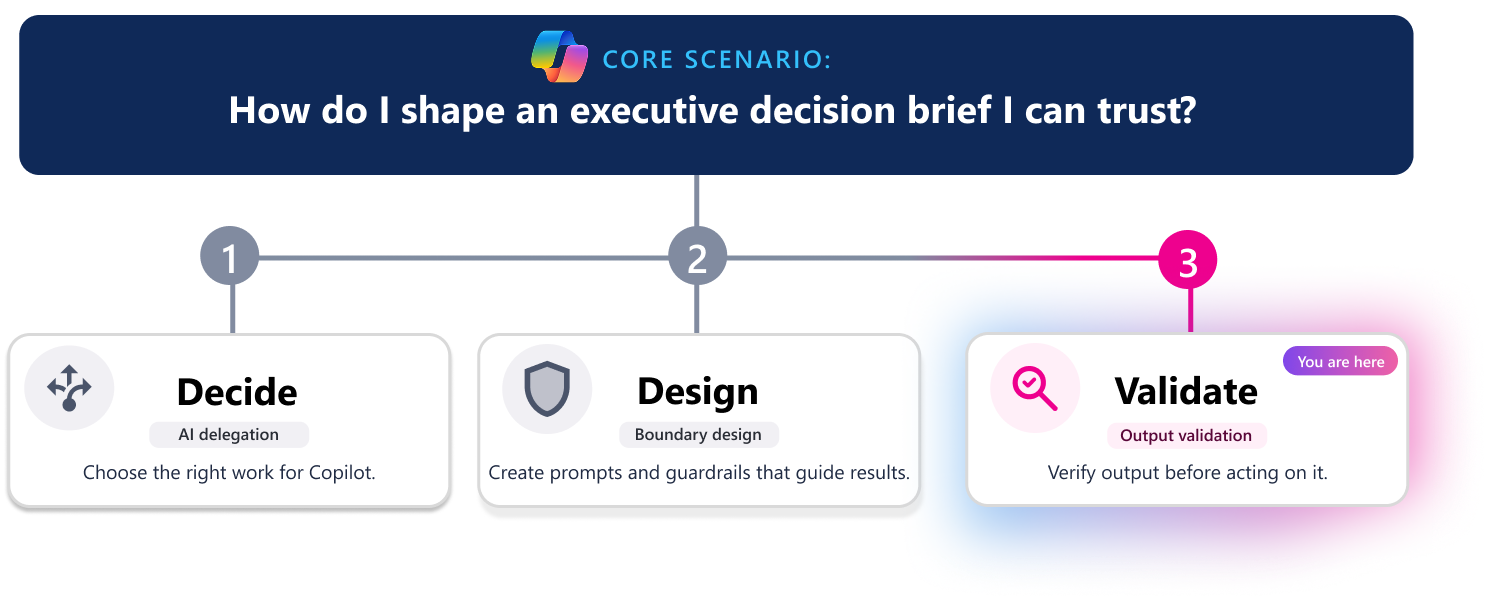
A decision brief can read well and still be risky to share. A date might be wrong, a caveat might be missing, or a recommendation might go further than the evidence supports. That is why validation matters.
This scenario shows how to validate a Copilot-generated decision brief to bridge the gap between having a draft and trusting it enough to share with stakeholders.
Scenario: Review your draft decision brief before you share it
You used Copilot to create a first draft of a decision brief for senior leaders about whether to continue, change, or stop a pilot after mixed results. The draft pulls together pilot findings, feedback themes, meeting notes, adoption data, early cost estimates, recommendations, major risks, and next steps.
It might feel close to ready, but the stakes are high. This decision brief could influence whether leadership invests more, expands the pilot, changes the approach, or ends the effort. If it overstates adoption, omits important caveats, treats estimates as facts, or recommends a direction the evidence doesn't support, it could lead to poor decisions.
Before you share it, you slow down and review what the draft is claiming. You check whether the recommendation matches the source material, whether key statements are supported, caveats are included, and the conclusion is strong enough to stand behind.
Copilot can help you identify gaps and surface questions, but you remain responsible for deciding whether the decision brief is accurate, complete, and ready to share.
What checks should I use to validate the decision brief?
Before you share the decision brief, validate it using these four checks: Source, Verified, Context, and Resilient.

Source
Does the decision brief accurately reflect the pilot evidence it came from?
| Do | Don’t | Ask Copilot |
|---|---|---|
| Trace key claims, recommendations, timelines, and risks back to source material. | Assume statements are accurate without checking the source. | “Compare this decision brief with the source material and highlight mismatches or unsupported claims.” |
| Confirm summaries preserve the original meaning and intent. | Rewrite or compress content in a way that changes meaning. | “Flag missing qualifications or context from the source.” |
| Treat anything untraceable as unconfirmed and request supporting evidence. | Leave unsupported or inferred claims in place. | “Suggest where supporting evidence is needed.” |
Verified
Are the critical details confirmed?
| Do | Don’t | Ask Copilot |
|---|---|---|
| Verify dates, numbers, budgets, owners, approvals, and scope boundaries. | Reuse details that haven’t been confirmed. | “Identify which facts, names, dates, and numbers require verification.” |
| Cross-check high-impact details against reliable sources. | Assume earlier drafts or estimates are still valid. | “Point to where each detail should be confirmed.” |
| Resolve ambiguous, conflicting, outdated, or placeholder details before sharing. | Treat “close enough” details as acceptable. | “Flag unclear or conflicting details.” |
Context
What is missing that could change the decision?
| Do | Don’t | Ask Copilot |
|---|---|---|
| Include assumptions, dependencies, constraints, and unresolved risks. | Present conclusions without supporting conditions or feasibility factors. | “Identify missing context that could change the recommendation.” |
| Clarify what must be true for timelines or outcomes to hold. | Make timelines or outcomes sound final when they depend on conditions. | “Highlight conditions or uncertainties that affect the recommendation, such as adoption, staffing, cost, or unresolved risks.” |
| Make implicit context explicit so stakeholders can interpret the decision brief accurately. | Assume stakeholders share the same background knowledge. | “Flag gaps that could lead to misinterpretation.” |
Resilient
Would this hold up if conditions change?
| Do | Don’t | Ask Copilot |
|---|---|---|
| Stress-test assumptions against different scenarios, audiences, and interpretations. | Assume best-case conditions will hold or that everyone will interpret the decision brief the same way. | “Identify scenarios that could break or weaken the decision brief.” |
| Evaluate how adoption shifts, dependency changes, costs, or delays could affect outcomes. | Ignore downstream effects of changing assumptions or slipping dependencies. | “Surface questions stakeholders might ask.” |
| Clarify uncertainty, conditional outcomes, and areas that might need flexibility. | Present conditional outcomes as guaranteed commitments. | “Suggest where to add flexibility or clarification.” |
Example: How validation changes a risky statement
| Before validation | After validation |
|---|---|
| The pilot was successful, so we should move forward with broader expansion. | The pilot shows encouraging results in some teams, but uneven adoption, open staffing questions, and unresolved implementation risks should be addressed before recommending broader expansion. |
| The initiative will reduce operational costs by 30% within the first year. | Based on the pilot results, the initiative could reduce operational costs by an estimated 15–30% within the first year, depending on adoption rates, implementation costs, and the final rollout model. |
The after versions are not just more cautious. They are more accurate, more useful, and less likely to mislead.
How can Copilot support validation without replacing human review?
Copilot can support the validation process. It can act as a:
- Reviewer that compares the draft with your sources.
- Challenger that surfaces assumptions.
- Gap finder that points out missing context.
- Stress tester that explores edge cases.
That support is useful, but it is not final proof that the draft is correct. For higher-stakes content, validation still depends on human judgment and trusted source material.
Quick readiness checklist
Before you share a Copilot-generated decision brief, confirm:
✔️ Source: Key claims match the source material.
✔️ Verified: Important facts and details are confirmed.
✔️ Context: Nothing important has been left out.
✔️ Resilient: The decision brief still holds up across questions, exceptions, and audiences.
If any one of those is unclear, validate further before sending it.
Why validation matters
Copilot can get you to a useful decision brief draft faster, but validation is what makes that draft responsible to share. It helps you catch weak claims, missing caveats, unsupported conclusions, and overconfident language before they affect decision-making.
Copilot can help draft and review the decision brief. You decide whether it is accurate, complete, and trustworthy enough to leave your hands.
Responsible Copilot use depends on thoughtful delegation, clear boundaries, and careful validation before you share the final decision brief.